Knit Stitch (k)
Last updated November 12, 2026
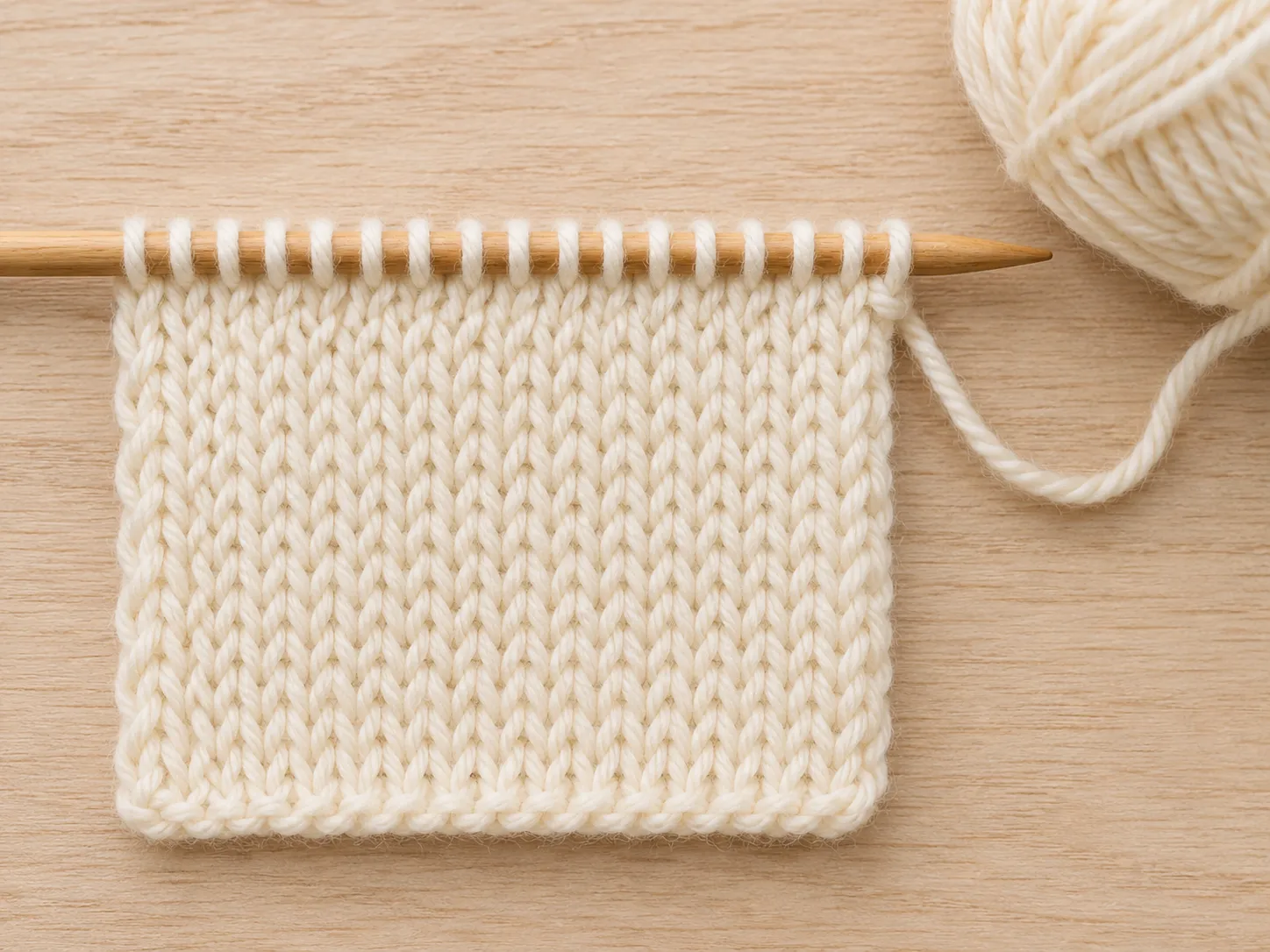
At a Glance
- Difficulty
- Beginner
- Abbreviation
- k
- Repeat
- Any number of stitches; knit every row for garter stitch, or alternate knit and purl rows for stockinette
Practice with: A smooth, light-colored worsted (aran) wool or wool blend with 5 mm (US 8) needles lets you see each loop clearly. Wooden or bamboo needles grip the stitches a little, which helps stop them sliding off while you learn.
Used For
- Garter stitch scarves and dishcloths
- The right side of stockinette fabric
- Ribbing, seed stitch and almost every other stitch pattern
- Learning to knit
The first stitch every knitter learns - a loop pulled through from back to front, making a smooth V on one side of the fabric and a bump on the other.
Every knitted fabric is built from just two stitches, and the knit stitch is the first of them. Each knit stitch pulls a new loop through the old one from back to front, so the side facing you shows a neat V and the other side shows a small horizontal bump. That bump is a purl stitch seen from behind, which is why knit and purl are really two views of the same loop.
What fabric you get depends on how you combine rows. Knit every row when working flat and you get garter stitch: squishy, reversible and lying flat, with one ridge for every two rows. Knit the right-side rows and purl the wrong-side rows and you get stockinette. Knit every round on circular needles and you also get stockinette, because you never turn the work and the V side always faces you.
English (throwing) and Continental (picking) styles produce exactly the same stitch. English is widespread in the UK and US; Continental is common across much of Europe, and many knitters find it quicker for moving between knits and purls. Neither is more correct - choose the one that feels comfortable and gives you even tension.
Instructions
- Hold the needle with your cast-on stitches in your left hand and the empty needle in your right. The working yarn (the strand coming from the ball) hangs at the back of the work, away from you.
- Insert the tip of the right needle into the front of the first stitch on the left needle, going from left to right and from front to back. The right needle now sits behind the left needle, and the two tips form an X.
- English style (throwing): hold the working yarn in your right hand and wrap it counterclockwise around the right needle - take it under the right needle tip and up over the top, so it lies between the two needle tips.
- Keeping the yarn snug, use the right needle tip to draw the new loop down and toward you through the center of the old stitch. The new loop is now on the right needle, in front of the left needle.
- Slide the old stitch off the end of the left needle. You have made one knit stitch, and it sits on the right needle.
- Repeat into each stitch until the left needle is empty. Swap the needles between your hands so the full needle is in your left hand, and start the next row.
- Continental style (picking): hold the working yarn in your left hand, draped over your index finger and tensioned through your other fingers. Insert the needle exactly as in step 2, then use the right needle tip to catch the yarn from your index finger and pull it through the old stitch, instead of wrapping it with your right hand.
Tips & Notes
- Keep your stitches near the tip of the left needle so you are not stretching each one to reach it, but form the new stitch on the thicker part of the right needle.
- Practice on 20 stitches or so - enough to find a rhythm, small enough to finish a row quickly and count easily.
- Learn to read your knitting early: a V below the needle is a knit stitch, a bump is a purl. It makes spotting and fixing mistakes far easier.
Common Mistakes
Twisted stitches: the two legs of the V cross at the bottom instead of sitting side by side.
This happens when you knit into the back of the stitch, or when a stitch sits on the needle backward (often after picking up a dropped stitch). Each stitch should sit with its front (right) leg in front of the needle; if one is reversed, knit it through the back loop to untwist it.
The piece gets wider as you go because extra stitches keep appearing.
Usually the yarn has come forward between the needles, making an accidental yarn over, or the first stitch has been pulled down so its two legs look like two stitches. Keep the yarn at the back and count your stitches at the end of every few rows.
A stitch slips off the left needle and a ladder runs down the fabric.
Catch the loose loop on a crochet hook from the front, hook the horizontal bar above it and pull it through, and repeat up the ladder one bar at a time until you reach the needle.
Variations
- Knit through the back loop (k1 tbl) - The needle enters the back leg of the stitch instead of the front, deliberately twisting it. Twisted stitches look crisp and raised and are used in twisted rib and Bavarian-style patterns.
- Combination knitting - Purl stitches are wrapped the opposite way, which leaves them mounted backward, so the next row's knits are worked through the back loop. The result looks like ordinary stockinette once the method is followed consistently.
In Patterns
Knit is abbreviated k, so k5 means knit the next 5 stitches and "k to end" means knit every remaining stitch on the row. On charts an empty square usually means knit on a right-side row (and purl on a wrong-side row), but always check the chart key.
Questions
Is knit stitch the same as garter stitch?
No - the knit stitch is the single movement, and garter stitch is the fabric you get when you knit every row of a flat piece. Knit stitches also make up the smooth side of stockinette and the raised columns of ribbing.
Should I learn English or Continental knitting?
Try both for a few rows and keep whichever feels natural. Many knitters learn the style their teacher used, and plenty later switch or learn both so they can hold one color in each hand for stranded colorwork.
Do I knit into the front or the back of the stitch?
Into the front leg, unless your pattern says tbl (through the back loop). Knitting into the back by accident is one of the most common beginner habits and gives twisted stitches.