Lazy Daisy Stitch (Detached Chain)
Last updated November 12, 2026
At a Glance
- Difficulty
- Beginner
- Repeat
- Single loops about 1/4-1/2 in (6-13 mm) long, usually 5-8 arranged around a center for a flower
Practice with: A firm cotton in a hoop, three strands of six-strand floss or perle cotton #8, and an embroidery (crewel) needle. Mark a center dot and a ring of petal tips to practice on.
Used For
- Flower petals
- Leaves
- Scattered decorative fills
- Silk ribbon embroidery
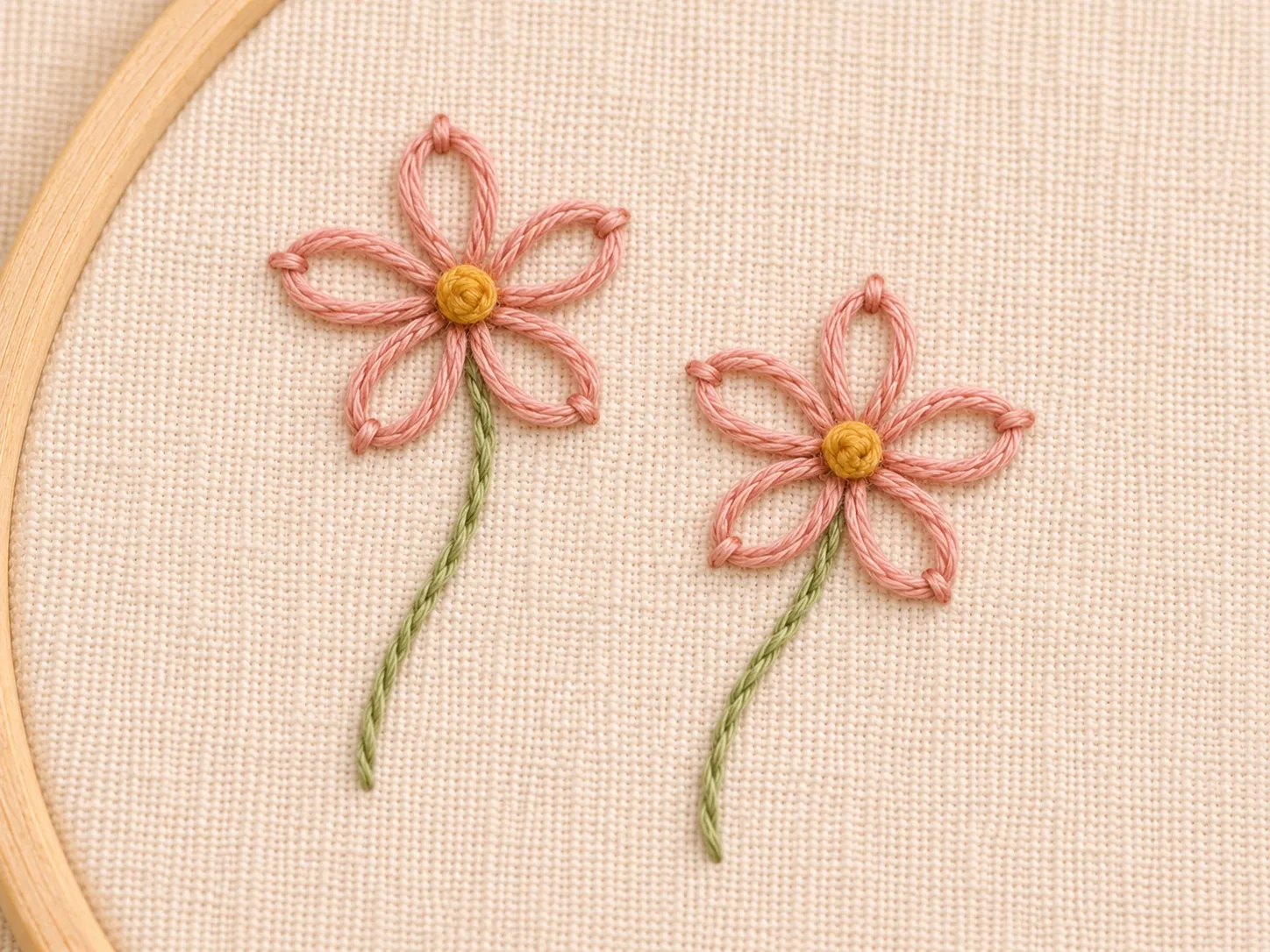
A single chain stitch held down at its tip with a tiny stitch, used for petals and leaves - five or more worked in a circle make the classic daisy.
A lazy daisy is a single chain stitch that isn't continued into a line. Each loop is held at its tip by a tiny tacking stitch, making a rounded, teardrop-shaped petal. It's one of the quickest ways to make a recognizable flower in embroidery, since each petal is a single stitch, and it's often one of the first decorative stitches beginners learn.
The loop's shape is easy to vary. Pulling it gently gives slim petals, while a relaxed loop or a thicker thread makes plump ones. Detached chains scattered at different angles also make a quick, textured fill, and they're one of the core stitches in silk ribbon embroidery, where the ribbon forms soft, dimensional petals.
In stitch guides it's often listed as 'detached chain stitch', which describes exactly how it relates to chain stitch. Fly stitch, which makes a V shape instead of a loop, and French knots, which are often used for the flower centers, pair naturally with it in floral designs.
Instructions
- Mark the flower center and the tip of each petal with small dots.
- Bring the needle up at the inner end of the first petal, close to the center.
- Insert the needle back down right beside where it came up, about one fabric thread away, and bring the tip out at the petal tip, without pulling it through yet.
- Loop the working thread under the needle tip, then pull the needle through gently until the loop lies flat in a petal shape.
- Take a tiny stitch over the end of the loop, just beyond the tip, to hold it down.
- Bring the needle up near the center for the next petal and repeat. Working the petals at the 12, 6, 3 and 9 o'clock positions first, then filling in between, keeps them evenly spaced.
- Finish the thread on the back, then add a French knot or a cluster of knots to the flower center if you like.
Tips & Notes
- Hold the loop in place with your thumb while you take the tacking stitch, so it doesn't shift or twist.
- Thicker threads such as perle cotton #5 make rounder, plumper petals than stranded floss.
- For leaves, angle a pair of lazy daisies along a stem worked in stem stitch.
Common Mistakes
The loop pulls through to the back when you tighten it.
The needle went down in exactly the same hole and the loop wasn't caught under the tip. Insert it a thread away and check the thread is under the needle before you pull through.
The petals are thin and flat instead of rounded.
You're pulling the loop too tight. Stop as soon as it lies flat, and use thicker thread or more strands for fuller petals.
The flower looks lopsided.
The petals weren't evenly spaced. Mark the center and the petal tips first, and work opposite petals before filling in between.
The tacking stitch is big and noticeable.
Keep it tiny, just over the end of the loop. A longer tack is only right when you want a deliberate tail.
Variations
- Double lazy daisy - A smaller loop worked inside a larger one, often in a different color, giving a two-toned petal.
- Long-tailed lazy daisy - The tacking stitch is extended into a long straight stitch, which can form a stem or the point of a leaf.
- Chain stitch - Lazy daisy loops worked one after another into a continuous line. It has its own page in this library.
In Patterns
Patterns say 'lazy daisy' or 'detached chain', and stitch diagrams show the petals as small teardrop loops with a tiny bar at the tip.
Questions
What's the difference between a lazy daisy and chain stitch?
A lazy daisy is one chain loop tacked down on its own. Chain stitch links loop after loop into a continuous line.
How many strands should I use for lazy daisy?
Two or three strands of floss are typical. For bold, plump petals, use perle cotton #5 or #8, or more strands.
Can I make leaves with lazy daisy stitch?
Yes. Work them in green, angled along a stem, and add a straight stitch inside each loop if you want a fuller leaf.