Overcast Stitch
Last updated November 12, 2026
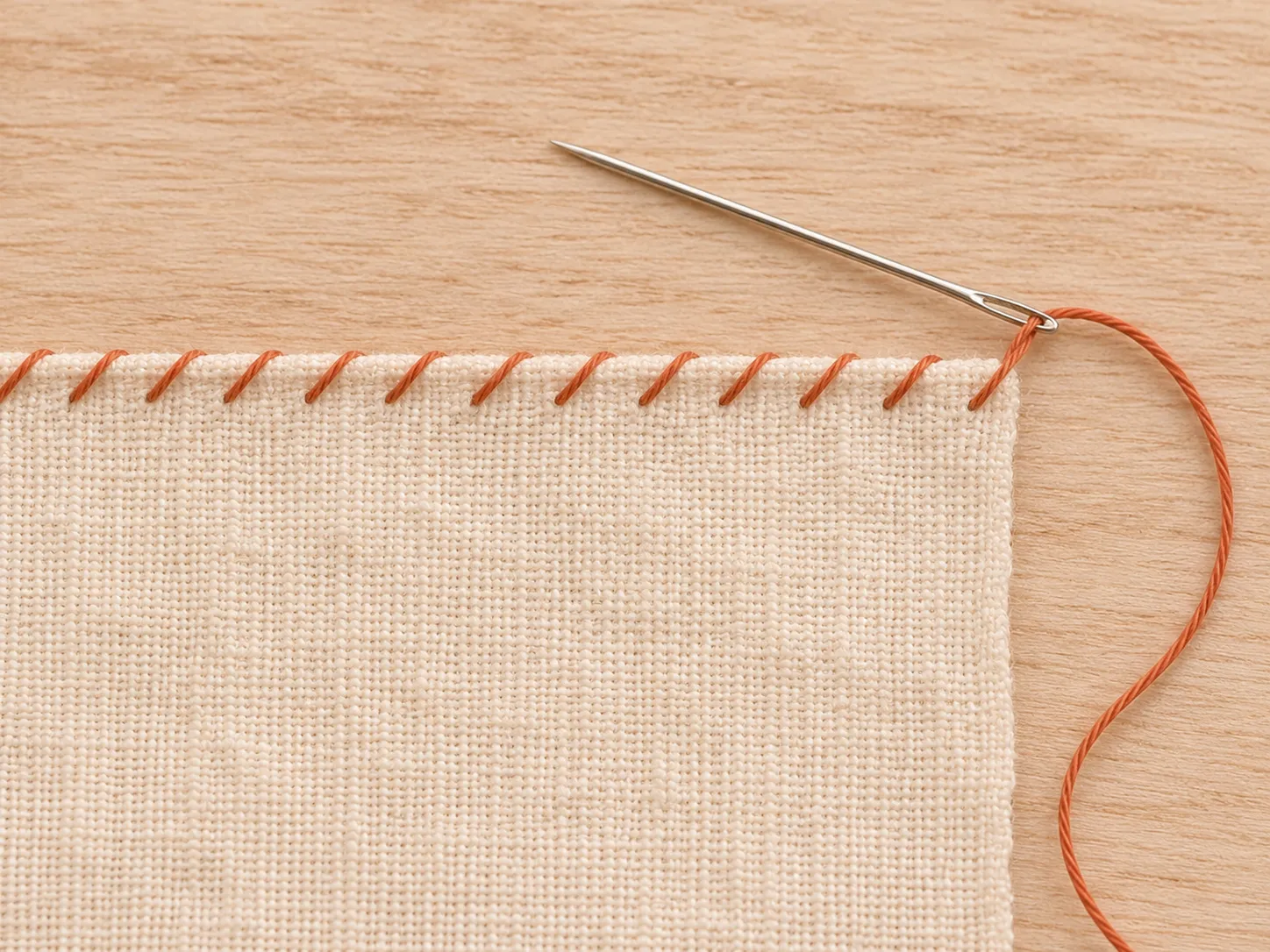
At a Glance
- Difficulty
- Beginner
- Repeat
- Stitches about 1/8-1/4 in (3-6 mm) deep and 1/4 in (6 mm) apart, all slanting the same way
Practice with: A firmly woven cotton scrap, a single strand of all-purpose thread matching the fabric, and a size 7-9 sharps needle. A loosely woven fabric is a useful second test, since it shows quickly whether your stitches are deep enough.
Used For
- Finishing seam allowances
- Stopping raw edges from fraying
- Fine fabrics that a machine finish would mark
- Reinforcing cut edges before other stitching
A hand stitch that wraps diagonally over a single raw edge to stop woven fabric fraying - the hand-sewn equivalent of a serged or zigzagged seam finish.
Overcasting does one job: it binds the threads at a raw edge so they can't work loose. The thread wraps diagonally over the edge again and again, holding the outermost threads of the weave in place. Before sergers and zigzag machines, this was the standard way to finish the seam allowances inside a garment, and it's still used in fine dressmaking.
A hand-overcast edge stays soft and flat, which is why it's favored for silk, fine wool and other delicate fabrics where a serged edge can show through as a ridge after pressing. It's slower than a machine finish, and on very loose weaves it controls fraying rather than stopping it completely, so deeper, closer stitches are needed there.
It's also a handy preparatory stitch. Overcasting the cut edges of a hand-worked buttonhole before buttonhole stitch keeps the slit from fraying while you work, and a quick overcast holds the edge of a patch or an appliqué piece steady before it's sewn down permanently.
Instructions
- Trim the raw edge straight and remove any loose threads. On a seam, overcast each allowance separately if the seam is pressed open, or both together if it's pressed to one side.
- Knot the thread and bring the needle out through the fabric from the back, about 1/8-1/4 in (3-6 mm) in from the edge.
- Take the thread over the edge to the back and, about 1/4 in (6 mm) further along, push the needle through from back to front at the same depth as before.
- Pull the thread just snug - it should lie over the edge without rolling it or drawing it up.
- Continue along the edge, always inserting the needle from the same side, so the edge is wrapped in a line of evenly slanted stitches.
- Finish with two small stitches on top of each other, then run the needle under the last few stitches and trim the tail.
Tips & Notes
- A line of machine straight stitching about 1/4 in (6 mm) from the edge, sewn first, stops the edge stretching and gives you a guide for stitch depth.
- Use a single strand; a doubled thread makes a lumpy edge that can show through as a ridge after pressing.
- On fabrics that fray badly, work a second pass back along the edge in the opposite direction, so the stitches cross.
Common Mistakes
The edge frays out from under the stitches.
The stitches are too shallow. Take them 1/8-1/4 in (3-6 mm) in from the edge, deeper and closer together on loosely woven fabrics.
The edge curls or rolls into a tube.
The thread is pulled too tight. Each stitch should just hug the edge; check by laying the fabric flat every few inches.
The stitches slant in different directions.
The needle is entering from alternate sides. Always insert it from the back, so every stitch wraps the same way.
Variations
- Whipstitch - The same wrapping motion used to join two edges together, usually with smaller, closer stitches. It has its own page in this library.
- Crossed overcasting - A second row of overcasting worked back along the edge in the opposite direction, so the stitches form small Xs. It's sturdier on fabrics that fray badly.
- Machine overcast - Most sewing machines have an overcast or zigzag stitch that sews over the edge in the same way. It's much faster, but leaves a firmer edge.
In Patterns
Patterns say 'overcast the raw edges' or 'finish seam allowances by overcasting'. 'Overcast' can also mean a machine overcast or zigzag stitch, so check whether hand or machine finishing is meant - either does the same job.
Questions
Is overcast stitch the same as whipstitch?
They use the same movement, and many books treat the names as interchangeable. In practice, 'overcast' usually means finishing a single raw edge with deeper, more widely spaced stitches, and 'whipstitch' means joining two edges with small, close ones.
Do I need to overcast if I have pinking shears?
Pinking is enough on firmly woven fabrics that don't fray much. On loose weaves, or on garments that will be washed often, overcasting lasts much better.
Should I overcast before or after sewing the seam?
Usually after sewing and pressing the seam, so you know which way the allowances lie. On fabrics that fray as soon as they're cut, a quick overcast before construction keeps the edges intact while you work.