Threading a Needle and Tying a Knot
Last updated November 12, 2026
At a Glance
- Difficulty
- Beginner
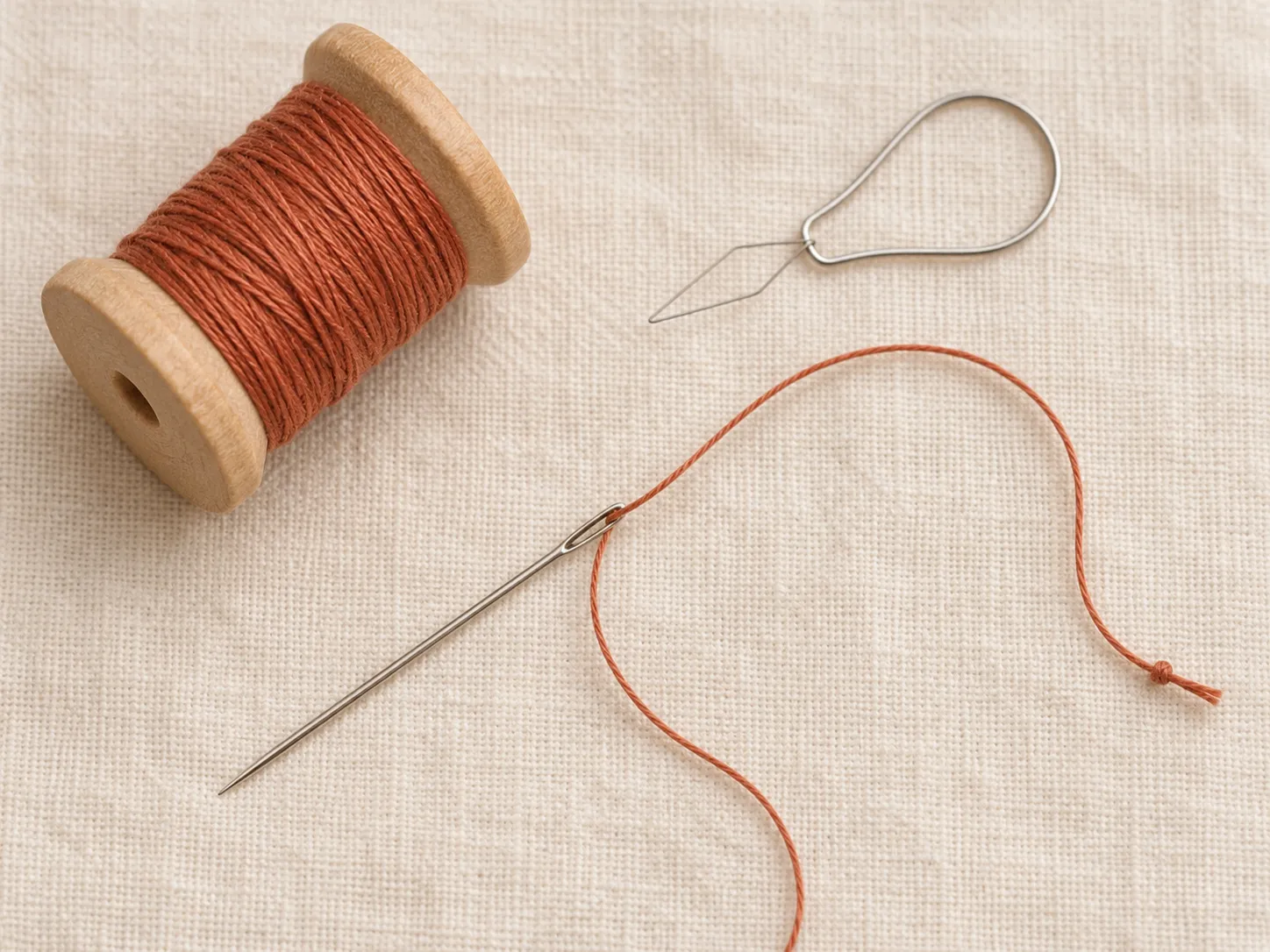
Practice with: A size 7-9 sharps needle, all-purpose polyester thread and small, sharp scissors. A wire needle threader helps with fine needles, and an embroidery (crewel) needle has a longer eye that takes floss more easily.
Used For
- Starting any hand-sewing project
- Sewing with single or double thread
- Sewing on buttons and mending
- Hand quilting and embroidery
How to thread a hand-sewing needle, cut a sensible length of thread, and tie a neat quilter's knot that won't pull through the fabric when you start.
Most of the frustration in hand sewing - tangles, knots that pull through, thread slipping out of the eye - comes from how the needle is threaded and the thread is started. A length of about 18-24 in (45-60 cm) is long enough to sew a useful distance but short enough not to twist and wear out as it passes repeatedly through the fabric.
The quilter's knot is worth learning because it makes a small, consistent, firm knot every time, right at the end of the thread. The quicker finger-roll knot, where you twist the end off your fingertip, works too but varies in size and can leave a loose tail. In quilting, the knot is gently tugged through the top layer so it lodges in the batting and disappears.
Embroiderers often avoid knots altogether, because a knot can make a lump on the front once the work is framed. Instead they start with a waste knot, which is cut off later, or a loop start, both of which anchor the thread under the first few stitches on the back.
Instructions
- Cut a length of thread about 18-24 in (45-60 cm) long. Cut it cleanly at a slight angle with sharp scissors rather than biting or snapping it, so the end isn't frayed.
- Hold the needle with the eye facing you against a plain, light background. Pinch the thread so only about 1/4 in (6 mm) of the end pokes out from your fingertips, and bring the eye down onto the thread rather than pushing the thread at the eye.
- Pull about 4-6 in (10-15 cm) of thread through the eye for sewing with a single thread, or pull the two ends level if you want a double thread.
- To tie a quilter's knot, hold the needle pointing up. Lay the end you want to knot against the needle, its tip pointing up toward the needle's point, and pinch thread and needle together between the thumb and index finger of your other hand.
- With your free hand, wrap the thread around the needle 2-3 times just above the pinch, then slide the wraps down into your fingers so you are pinching them too.
- Keeping the wraps pinched, pull the needle up by its point and keep pulling until all the thread has slid through your fingers and the wraps tighten into a neat knot at the very end.
- Trim any tail beyond the knot to about 1/8 in (3 mm).
Tips & Notes
- Thread several needles before a long session of hand sewing, so you don't have to stop and rethread in the middle of a seam.
- If the thread end is fuzzy, run it over beeswax or a thread conditioner, or recut it - a clean end goes through the eye far more easily than a damp, twisted one.
- For a double thread, knot both ends together with one quilter's knot so the two strands stay the same length.
Common Mistakes
The thread won't go through the eye.
The end is frayed or the needle's eye is too small for the thread. Recut the end cleanly at an angle, use a needle threader, or switch to a needle with a larger eye.
The knot pulls straight through the fabric.
It's too small for the weave. Add an extra wrap to the quilter's knot, or take one small backstitch after the knot so the thread is anchored even if the knot slips.
The needle keeps coming unthreaded while you sew.
The short tail is too short. Leave 4-6 in (10-15 cm), or pierce the short tail with the needle point near the eye and slide it down to lock the thread in place.
A double thread tangles and loops as you sew.
The two strands are twisting at different rates. Use a shorter length, run the thread over beeswax or a conditioner, and let the needle hang every so often to untwist.
Variations
- Finger-roll knot - Wrap the thread end once around your index finger, roll it off with your thumb so it twists, then pinch and pull to tighten. It's quick but less consistent than a quilter's knot.
- Waste knot - An embroidery start: knot the end and take the needle down on the front a few inches from where you'll stitch. Work over the tail on the back, then snip the knot off.
- Loop start - For an even number of strands: fold one strand in half and thread both cut ends through the eye. After the first stitch, pass the needle through the loop on the back to anchor it, with no knot at all.
Questions
Should I sew with a single or double thread?
Use a single thread for most seams, hems and anything meant to be invisible - it's finer and tangles less. Use a double thread for buttons, heavy repairs and other jobs where strength matters more than discretion.
Which end of the thread should I knot?
Many sewers thread the end that came off the spool first and knot the end they cut, finding the thread twists less that way. It's worth trying if your thread keeps tangling.
What do needle sizes mean?
For hand-sewing needles, a higher number means a finer, shorter needle. Sharps in sizes 7-9 suit general sewing, while quilters often use short 'betweens' in sizes 9-12 for small, even stitches.