Weaving In Ends
Last updated November 12, 2026
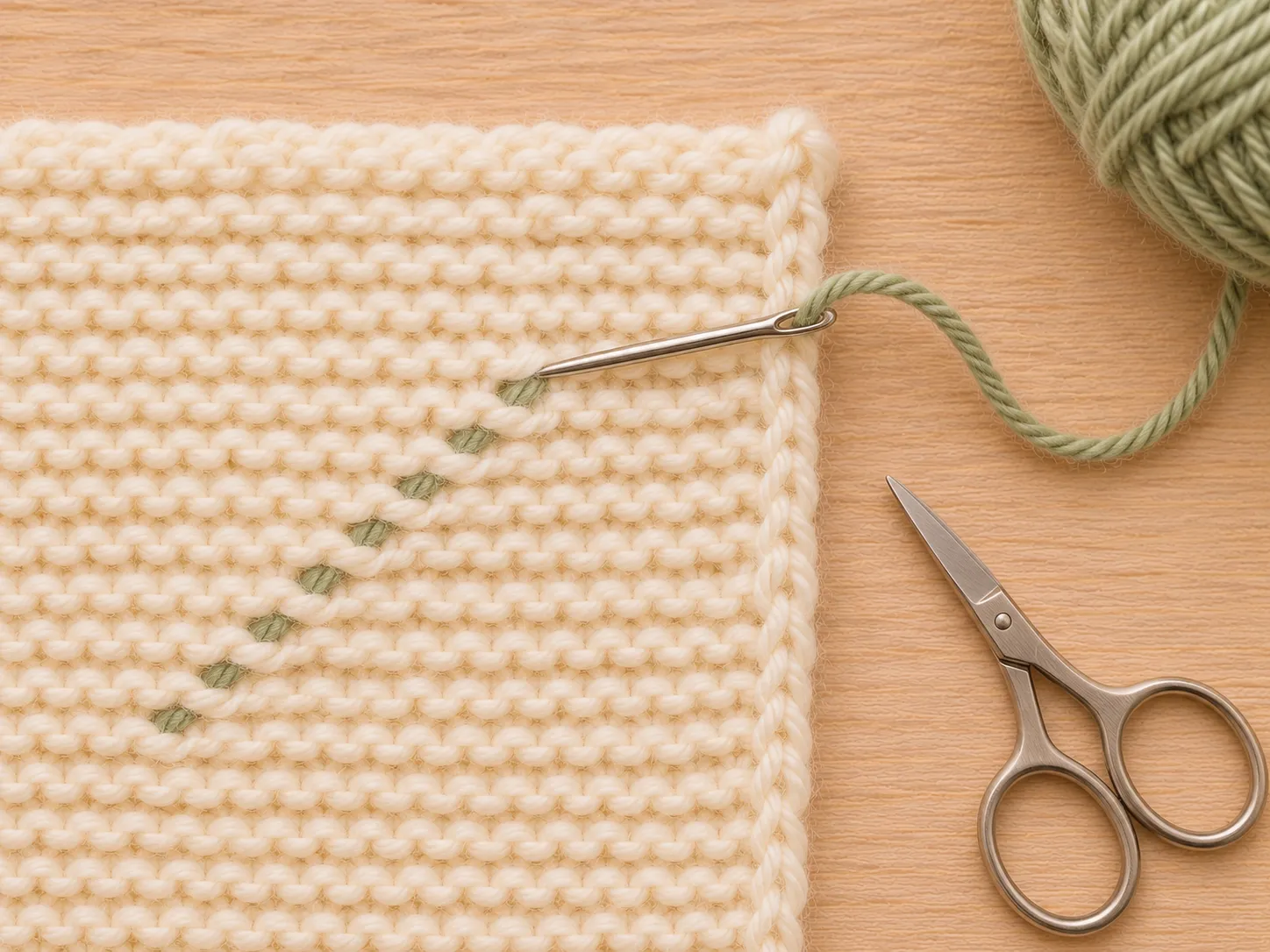
At a Glance
- Difficulty
- Beginner
- Repeat
- Leave tails of at least 6 in (15 cm); weave each one for about 2-3 in (5-7.5 cm), changing direction at least once
Practice with: A blunt tapestry needle with an eye large enough for your yarn, and sharp scissors. A needle with a bent tip makes it easier to scoop through the purl bumps.
Used For
- Finishing any knitted project
- Securing tails from color changes
- Hiding ends in seams
- Neatening cast-on and bind-off tails
How to hide and secure yarn tails in knitting so they stay put and don't show, using duplicate stitch on stockinette and purl bumps or garter ridges.
Every project ends with yarn tails - at the cast-on, the bind-off and every join or color change - and they need to be secured so they don't unravel or poke out. Weaving in ends means threading each tail through the back of the fabric, following the existing stitches so it is invisible from the front.
The best method depends on the fabric. Stockinette suits duplicate-stitch weaving, which hides the tail along the path of the yarn. Garter stitch and the bumpy wrong side of stockinette suit weaving along the purl bumps. Seams and edges are the easiest places of all, as the tail can run up the seam allowance.
Slippery fibers like silk, cotton and superwash wool need longer tails and extra direction changes. Going through the plies of the yarn as you weave - splitting it - adds more grip.
Instructions
- Leave a tail of at least 6 in (15 cm) whenever you start or end a strand of yarn, so there is enough to weave in.
- Thread the tail onto a blunt tapestry needle. Fold the end over the needle, pinch the fold tight and push it through the eye.
- Work on the wrong side. On stockinette, use duplicate-stitch weaving: follow the path of the existing yarn in a row of stitches, taking the needle under the same loops it passes through, so the tail lies on top of an existing strand and doesn't show on the right side.
- On garter stitch, or along the purl bumps on the wrong side of stockinette, run the needle under the purl bumps along one ridge or row, then turn and come back along the next ridge or row in the opposite direction.
- Work about 2-3 in (5-7.5 cm) in total, changing direction at least once. Skipping the last loop when you turn helps lock the tail in place.
- Check the right side as you go and keep the tension relaxed, so the fabric doesn't pucker.
- Wash or block the piece first, then trim the tail to about 1/4 in (6 mm). Trimming after blocking lets the tail settle without retracting to the surface.
Tips & Notes
- Join new balls at the edge of a flat piece where possible, so the tails can be woven into the seam.
- For colorwork, weave each tail into an area of the same color.
- Weave in ends as you go on larger projects so the finishing doesn't pile up.
Common Mistakes
Tails work loose and poke out after washing.
They were too short or woven in only one direction. Weave a longer length, change direction at least twice and trim only after blocking.
The tail shows on the right side as a line or pucker.
You may be going through to the front or pulling too tight. Stay in the purl bumps or the wrong-side half of the stitches and keep the tension relaxed.
A woven-in area of ribbing loses its stretch.
Weave along a column of stitches, up and down, rather than across the row. That way the tail moves with the rib.
Variations
- Weaving as you knit - When joining a new color, you can trap the old tail behind the work for a few stitches as you knit, so there's less to weave in later. It is common in stranded colorwork.
- Spit splice - For feltable (non-superwash) animal fibers, two ends are overlapped, moistened and rubbed together until they felt into one strand, so there are no ends to weave in.
- Russian join - Each end is threaded back through itself to make interlocking loops, joining a new strand with no tails to weave in. It works on most fibers.
In Patterns
Patterns rarely spell it out - the finishing section will just say "weave in ends" or "weave in all ends and block".
Questions
How long should yarn tails be?
At least 6 in (15 cm). That gives enough to thread a needle and weave in comfortably.
Should I weave in ends before or after blocking?
Weave them in before blocking, then trim after. The tails relax with the fabric during blocking and are less likely to pull out.
Can I just tie a knot?
Knots can work loose and often show on the right side. Weaving in is more secure and invisible.