Basic Bind-Off (UK: Cast Off) (BO)
Last updated November 12, 2026
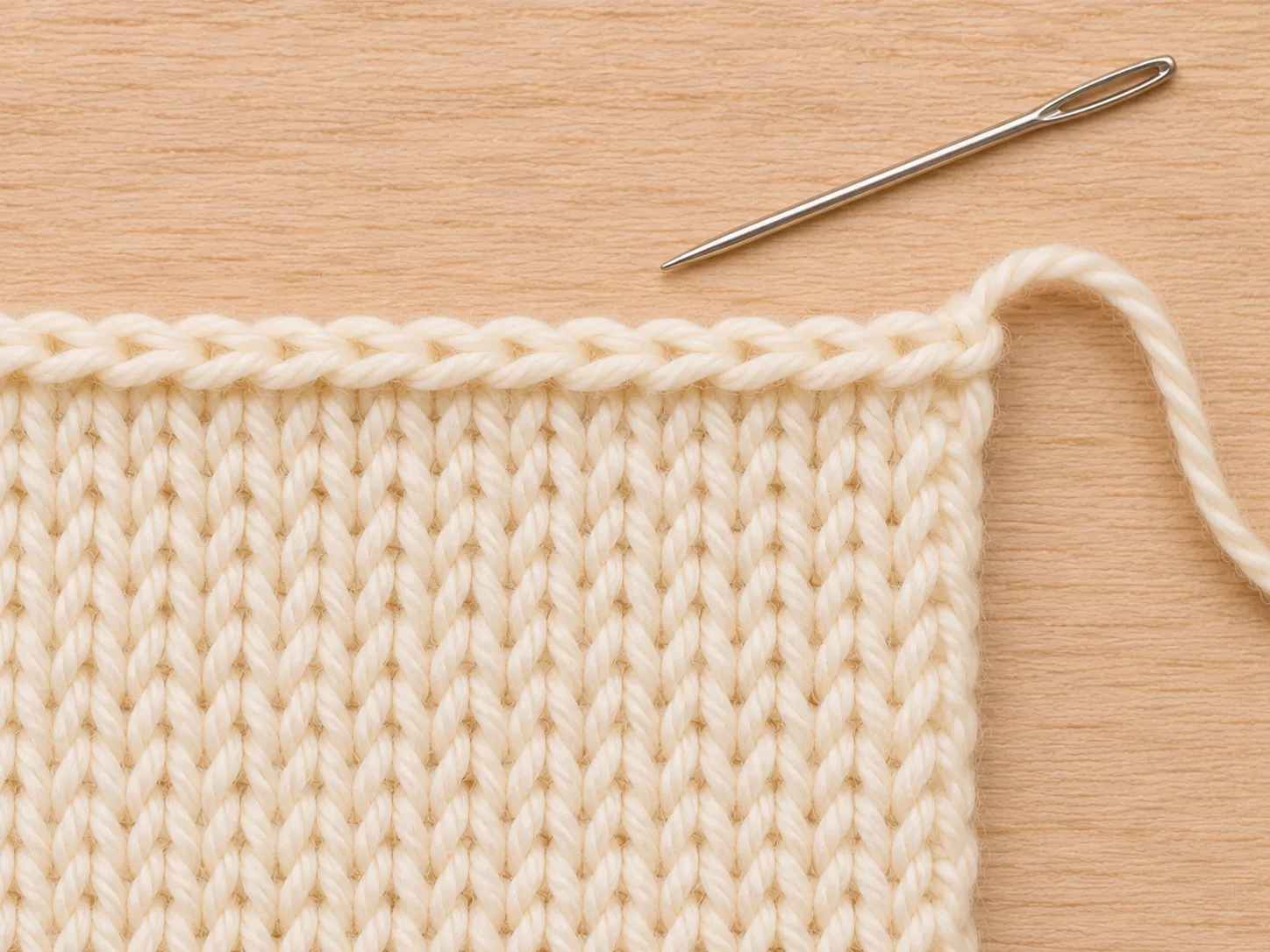
At a Glance
- Difficulty
- Beginner
- Abbreviation
- BO
- Repeat
- Works on any number of stitches; removes all stitches from the needle (or the number your pattern states)
Practice with: Use the yarn from your project. Keep a needle one or two sizes larger than your working needle on hand in case your bind-off comes out tight.
Used For
- Finishing any flat piece of knitting
- Shaping armholes and necklines
- Buttonholes
- Top edges of scarves, blankets and dishcloths
The standard way to finish knitting: lift each stitch over the next to lock the live loops into a neat chain edge that won't unravel.
Binding off (called casting off in the UK) secures the live stitches at the end of a piece so they can come off the needle without unraveling. Each stitch is passed over its neighbor, linking them into a chain that runs along the top edge. The finished edge is a neat chain, close in look to many cast-on edges, so the two ends of a scarf or blanket look similar.
The basic bind-off is firm and has little stretch. That suits most edges, but it can be a problem on ribbed necklines, cuffs and toe-up sock cuffs, which need to stretch. Binding off in pattern and using a larger needle both help, and there are dedicated stretchy bind-offs for edges that must expand a lot.
The same technique is used to bind off just a few stitches at a time - at the underarm of a sweater, for example, or at a buttonhole.
Instructions
- Knit the first two stitches of the row, so there are 2 stitches on the right needle.
- Insert the left needle tip into the front of the first stitch you knitted - the one farther from the tip of the right needle - going from left to right.
- Lift that stitch up and over the second stitch and off the right needle. One stitch is bound off and 1 stitch remains on the right needle.
- Knit the next stitch from the left needle so there are 2 stitches on the right needle again, then lift the first one over the second and off, as before.
- Repeat step 4 until the left needle is empty and 1 stitch remains on the right needle.
- Cut the yarn, leaving a tail of about 6 in (15 cm). Pull the last loop up a little, pass the tail through it and pull firmly to fasten off.
Tips & Notes
- Stop and count when binding off a set number of stitches - count the pass-overs, not the stitches you have knitted.
- For a very stretchy edge, bind off in pattern with a larger needle, or use a dedicated stretchy bind-off.
- Leave a longer tail if you will use it to sew a seam later.
Common Mistakes
The bound-off edge is tight and pulls the fabric in.
Bind off loosely, working the stitches with a needle one or two sizes larger in your right hand. Don't tug the yarn after each pass-over.
Stitches drop off the needle while you bind off.
You may be lifting the second stitch over the first. Always lift the stitch farther from the needle tip over the one nearer the tip, and keep a finger on the remaining stitch.
A loose, pointed loop sticks up at the end of the bind-off.
Pull the last stitch snug before cutting the yarn, then use a tapestry needle to take the tail down into the edge stitch below as you weave it in, which flattens the corner.
Variations
- Bind off in pattern - Work each stitch as it appears (knit or purl) before passing the previous stitch over it. It keeps ribbed edges neater and slightly more elastic.
- Three-needle bind-off - Two sets of live stitches are knitted together and bound off at the same time, joining them into a firm seam, often used for shoulders.
- I-cord bind-off - A few extra stitches are cast on and worked as an i-cord along the edge, giving a rounded, decorative finish. See the I-Cord page.
In Patterns
Patterns write bind off as BO (US) or cast off (UK). "BO in pattern" means knit the knit stitches and purl the purl stitches as you bind off. In a partial bind-off such as "BO 5 sts, k to end", the stitch left on the right needle after the fifth pass-over counts as the first of the stitches you go on to knit.
Questions
Is binding off the same as casting off?
Yes - bind off is the US term and cast off is the UK term. The method is identical.
Should I bind off on the right side or wrong side?
Follow your pattern. If it doesn't say, most knitters bind off on a right-side row, working the stitches in pattern.
How do I bind off in purl?
Purl the first two stitches, then pass the first over the second exactly as you would for knit. Continue purling one and passing one over.