Double Crochet Two Together (dc2tog)
Last updated November 12, 2026
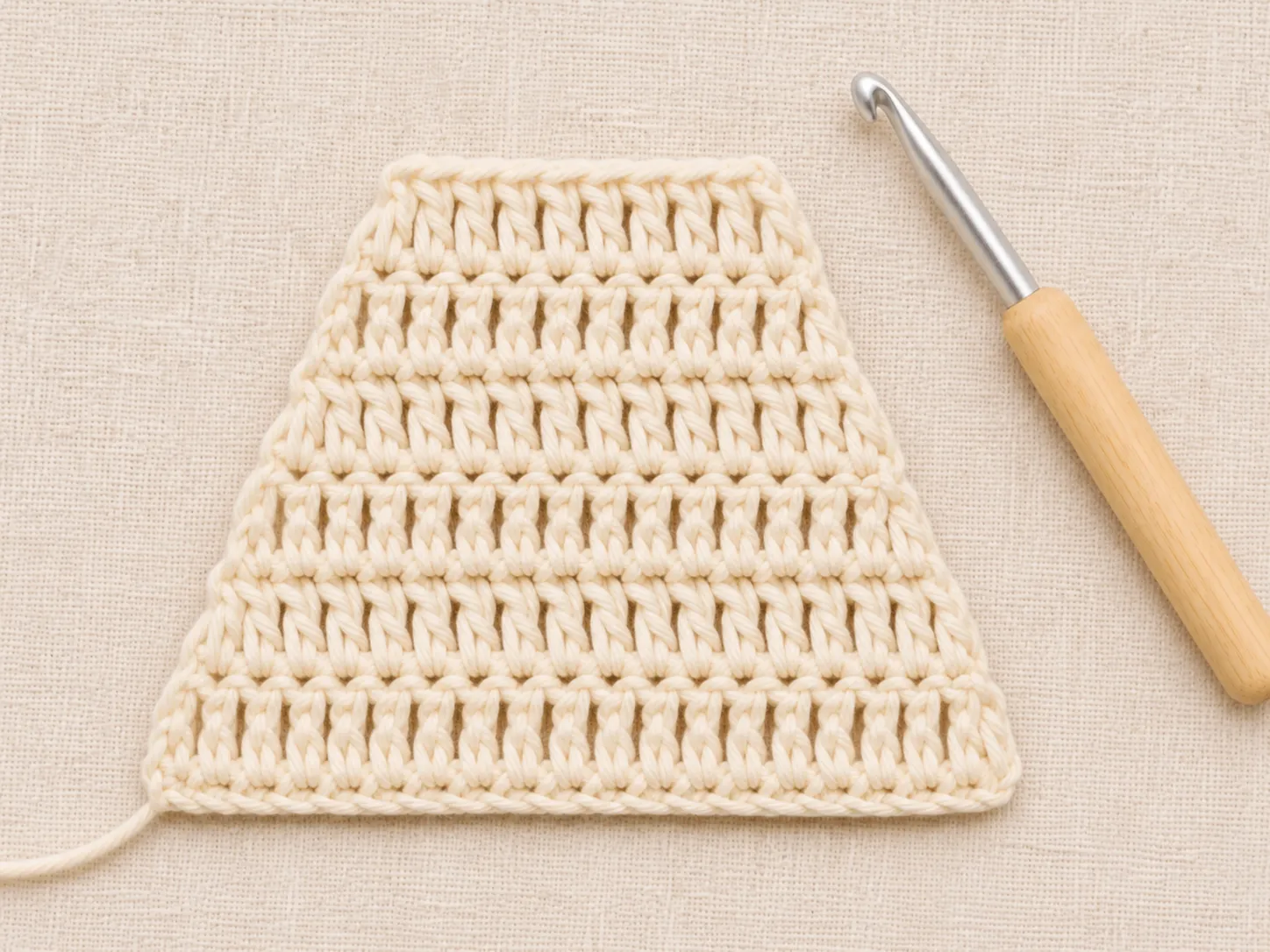
At a Glance
- Difficulty
- Beginner
- Abbreviation
- dc2tog
- UK name
- Treble two together (tr2tog)
- Repeat
- Worked over any 2 stitches; decreases 1 stitch
Practice with: A smooth worsted (aran) yarn and a 5 mm (US H-8) hook let you count the loops on the hook clearly.
Used For
- Shaping double crochet garments
- Valleys in ripple and chevron patterns
- Decreasing granny and lace patterns
- Tapering shawls and triangles
A double crochet decrease that joins two half-finished double crochets at the top, turning two stitches into one for shaping and ripple valleys.
In UK terms this stitch is called Treble two together (tr2tog). This page uses US crochet terms - see the US vs UK crochet terms chart to convert.
Dc2tog works like sc2tog but with double crochets. Each of the two stitches is worked up to its last step, leaving one loop from each on the hook, and the final yarn over joins them. The two legs fan out from a single top, which is why the decrease looks like an upside-down V.
It is the usual decrease for shaping double crochet fabric, and in ripple blankets you will see it, or its three-stitch cousin dc3tog, at the bottom of each valley. Combined with increases at the peaks, it creates the zigzag.
If both legs go into the same stitch, there is no decrease - you have made a 2-double-crochet cluster instead. The method is the same, only the placement differs.
Instructions
- Yarn over, insert the hook into the next stitch, yarn over and pull up a loop - 3 loops on the hook.
- Yarn over and draw through 2 loops - 2 loops remain. This is a half-finished double crochet.
- Yarn over, insert the hook into the following stitch, yarn over and pull up a loop - 4 loops on the hook.
- Yarn over and draw through 2 loops - 3 loops remain.
- Yarn over and draw through all 3 loops. Two stitches have been joined into one, so you have decreased 1 stitch.
- On the next row, the top of the dc2tog counts as one stitch, so work just one stitch into it.
Tips & Notes
- Count the loops on your hook at each stage: 3, then 2, then 4, then 3, then 1.
- Place the decrease consistently, one stitch in from the edge or at the same point in each repeat, so the shaping stays neat.
- If dc2tog looks loose, try pulling the last yarn over a little more firmly.
Common Mistakes
You finish with only 1 loop after the first half-stitch.
You have drawn through all loops instead of just 2. Each half-stitch stops with one extra loop left on the hook.
The stitch count doesn't go down.
Both legs were worked into the same stitch, making a cluster. The second leg must go into the next stitch.
A pattern's dc2tog comes out much shorter than expected.
The pattern may use UK terms, where dc2tog means a single crochet decrease. Check the pattern's notes for US or UK terms.
Variations
- Double crochet three together (dc3tog) - Three half-finished double crochets are joined, decreasing 2 stitches. It is common at the valleys of ripples.
- Cluster - The same steps worked into one stitch or space. It keeps the stitch count the same. See the Cluster Stitch page.
In Patterns
Written dc2tog, sometimes in a repeat like "dc in next 3 sts, dc2tog". UK patterns call this tr2tog. Some charts show it as two double crochet symbols joined at the top.
Questions
How do I decrease at the start of a row in double crochet?
Patterns vary, so follow yours. A common method is chain 2 (not counted as a stitch), then dc2tog over the first two stitches.
What is the difference between dc2tog and a cluster?
A dc2tog spans two stitches and decreases one; a cluster puts all the legs into one stitch and doesn't change the count.
Is dc2tog the same in UK patterns?
No - UK dc2tog is the US sc2tog. The US dc2tog is called tr2tog in UK terms.