Knit Two Together (k2tog)
Last updated November 12, 2026
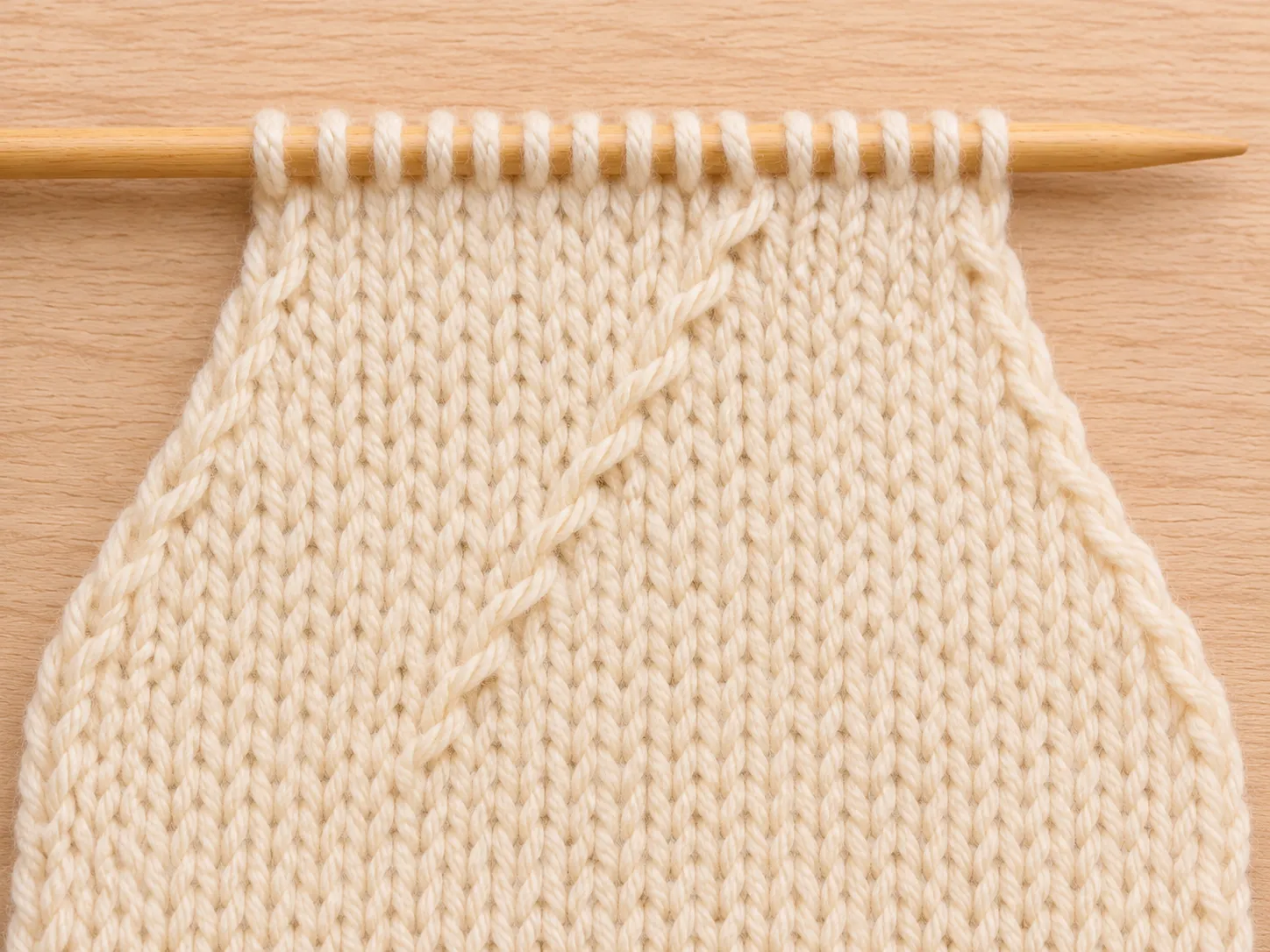
At a Glance
- Difficulty
- Beginner
- Abbreviation
- k2tog
- Repeat
- Works on any two adjacent stitches; decreases 1 stitch
Practice with: A smooth, light-colored worsted (aran) yarn on 5 mm (US 8) needles shows the slant of the decrease clearly. Sharper needle tips make it easier to go into two stitches at once.
Used For
- Shaping necklines, armholes and sleeves
- Decreasing at the crown of a hat or toe of a sock
- Pairing with yarn overs in lace and eyelets
- Mirrored shaping alongside ssk
The simplest knitting decrease: knit two stitches at once as if they were one, removing a stitch and making a decrease that leans to the right.
Knit two together is usually the first decrease a knitter learns, because it is just a knit stitch worked into two loops instead of one. The second stitch ends up lying over the first, so the decrease slants to the right on the right side of the work.
Decreases are how knitting gets narrower - think of the curve of a neckline, the taper of a sleeve or the closing circle at the top of a hat. Patterns often pair k2tog with its left-leaning mirror, ssk, so the shaping lines are symmetrical on each side of a garment. In lace, k2tog is paired with a yarn over: the yarn over makes a hole and adds a stitch, and the k2tog takes that stitch away again so the count stays the same.
Its purl-side equivalent is p2tog, which looks the same as k2tog from the right side.
Instructions
- Knit to the point where your pattern calls for the decrease.
- Insert the right needle into the next two stitches on the left needle at the same time, knitwise - from left to right and front to back. The needle goes into the second stitch first and then through the first.
- Wrap the yarn around the right needle as for an ordinary knit stitch.
- Pull the new loop through both stitches at once.
- Slide both old stitches off the left needle together. Two stitches have become one, so you have decreased 1 stitch.
- Check the result on the right side: the decrease leans to the right, with the second stitch lying on top of the first.
Tips & Notes
- When decreasing on both edges, put k2tog at the end of the row and ssk at the start so each decrease slants the same way as the edge it shapes - unless your pattern specifies otherwise.
- If your k2tog stitches look much tighter than the rest, try a slightly looser tension on the stitches immediately before them.
- Use a stitch marker to remind yourself where repeated decreases go.
Common Mistakes
The decrease leans the wrong way or looks twisted.
You have probably gone into the stitches through the back loops, which makes a k2tog tbl. Insert the needle from the front, left to right, just as for a normal knit stitch.
The needle won't fit into both stitches.
The stitches are too tight on the needle. Push them toward the tip, wiggle the needle in one stitch at a time, and keep your tension a little looser on the row before decreases.
The stitch count is wrong after a decrease row.
It is easy to slip only one stitch off, or to skip a decrease. Count your stitches after every shaping row and compare with the number given in the pattern.
Variations
- Purl two together (p2tog) - Purl two stitches together as if they were one. Worked on a wrong-side row, it gives a right-leaning decrease when seen from the right side.
- Knit three together (k3tog) - Three stitches are knitted together as one, decreasing 2 stitches with a right lean. It is common in lace and at the points of zigzags.
- Slip, Slip, Knit - The left-leaning partner of k2tog. Use it on the opposite side of the shaping to mirror the slant.
In Patterns
Written as k2tog, often in a repeat such as "*k6, k2tog; rep from * to end" for a hat crown, or "k to last 3 sts, k2tog, k1" for edge shaping. On charts it is usually shown as a diagonal line slanting up to the right.
Questions
Does k2tog lean left or right?
Right. The stitch on the left lies over the stitch on the right, so the decrease slants toward the right on the right side of the fabric.
What decrease mirrors k2tog?
Ssk (slip, slip, knit) is the usual left-leaning mirror. Skp (slip 1, knit 1, pass slipped stitch over) is another left-leaning option.
Where should I place k2tog at the edge of a piece?
Many patterns work it one or two stitches in from the edge, which leaves a clean edge stitch for seaming or picking up later.