Slip, Slip, Knit (ssk)
Last updated November 12, 2026
At a Glance
- Difficulty
- Beginner
- Abbreviation
- ssk
- Repeat
- Works on any two adjacent stitches; decreases 1 stitch
Practice with: A smooth, light-colored worsted (aran) yarn on 5 mm (US 8) needles makes the left slant easy to see. Practice k2tog and ssk side by side on the same swatch.
Used For
- Mirroring k2tog in symmetrical shaping
- Raglan, neckline and sleeve decreases
- Left-leaning decreases in lace
- Gusset shaping in socks
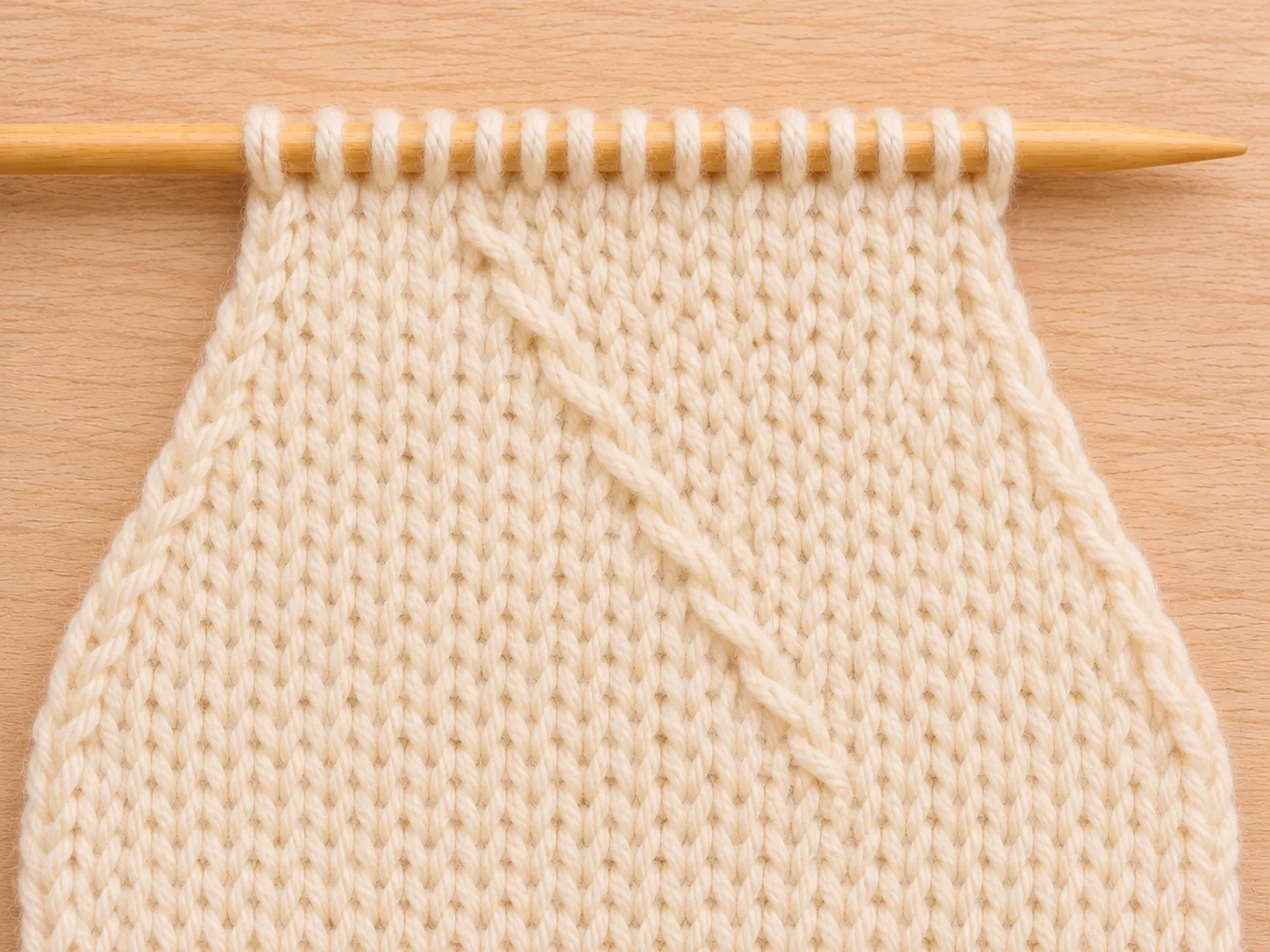
A left-leaning decrease that mirrors k2tog: slip two stitches knitwise one at a time, then knit them together through the back loops.
Ssk is the standard left-leaning decrease and the mirror image of k2tog. Slipping each stitch knitwise turns it around on the needle, so when you knit the two together through the back loops they lie flat rather than twisted, with the first stitch on top. That top stitch is what gives the slant to the left.
In shaping you will often see ssk at the beginning of a row and k2tog at the end, so the decreases form two symmetrical lines that slant the same way as the edges they shape, leaning in toward the center. Raglan sleeves, V-necks and sock gussets all rely on this pairing. In lace, ssk is paired with yarn overs to make holes that lean the opposite way to k2tog eyelets.
Many knitters find ssk looks a little looser than k2tog. That is normal, and the variations below can tighten it.
Instructions
- Work to the point where your pattern calls for the decrease.
- Insert the right needle into the next stitch knitwise (from left to right, front to back) and slip it onto the right needle without working it.
- Slip the next stitch knitwise in the same way. Both slipped stitches now sit on the right needle with their front legs turned toward the back.
- Insert the left needle tip into the fronts of both slipped stitches from left to right, so the left needle lies in front of the right needle.
- Wrap the yarn around the right needle as for a knit stitch and pull the new loop through both stitches. You have knitted them together through the back loops.
- Slide both old stitches off the left needle. One stitch is decreased, and on the right side the decrease leans to the left.
Tips & Notes
- Practice k2tog and ssk side by side on a swatch so you learn what each slant looks like.
- Count the stitches after the decrease row - a missed ssk is easy to overlook in lace.
- If you find the needle hard to insert, push the slipped stitches toward the tip of the right needle first.
Common Mistakes
The two stitches in the decrease look twisted.
Both stitches must be slipped knitwise. If you slip them purlwise and then knit through the back loops, they stay twisted.
The ssk is noticeably looser or more open than the k2tog on the other side.
Snug the working yarn firmly as you complete the ssk and as you knit the next stitch. Or try the improved ssk described below.
The decrease leans right instead of left.
You may have slipped both stitches together in one move and then knitted them in the front, which turns it into a k2tog. Slip one at a time and knit through the back loops.
Variations
- Improved ssk - Slip the first stitch knitwise and the second purlwise, then knit them together through the back loops. The second stitch sits a little flatter, giving a neater decrease.
- Slip 1, knit 1, pass slipped stitch over (skp) - An older left-leaning decrease: slip one stitch knitwise, knit the next, then lift the slipped stitch over it. It looks similar to ssk and can usually be substituted for it.
- Slip, slip, purl (ssp) - The wrong-side version: slip two stitches knitwise one at a time, return them to the left needle and purl them together through the back loops. It leans left when seen from the right side.
In Patterns
Written as ssk, for example "k1, ssk, k to last 3 sts, k2tog, k1" for a decrease row that shapes both edges. On charts it is usually a diagonal line slanting up to the left.
Questions
What is the difference between ssk and k2tog?
They both decrease 1 stitch, but k2tog leans right and ssk leans left. Using both lets you make shaping that mirrors from one side to the other.
Can I use skp instead of ssk?
In most patterns, yes - both lean left. Skp shows a slightly more stretched stitch on top, so use whichever looks better to you, and stay consistent.
Why slip the stitches knitwise?
Slipping knitwise turns each stitch around so that knitting through the back loops untwists it again. That gives a flat, neat decrease.