Make One Increase (M1L and M1R) (M1)
Last updated November 12, 2026
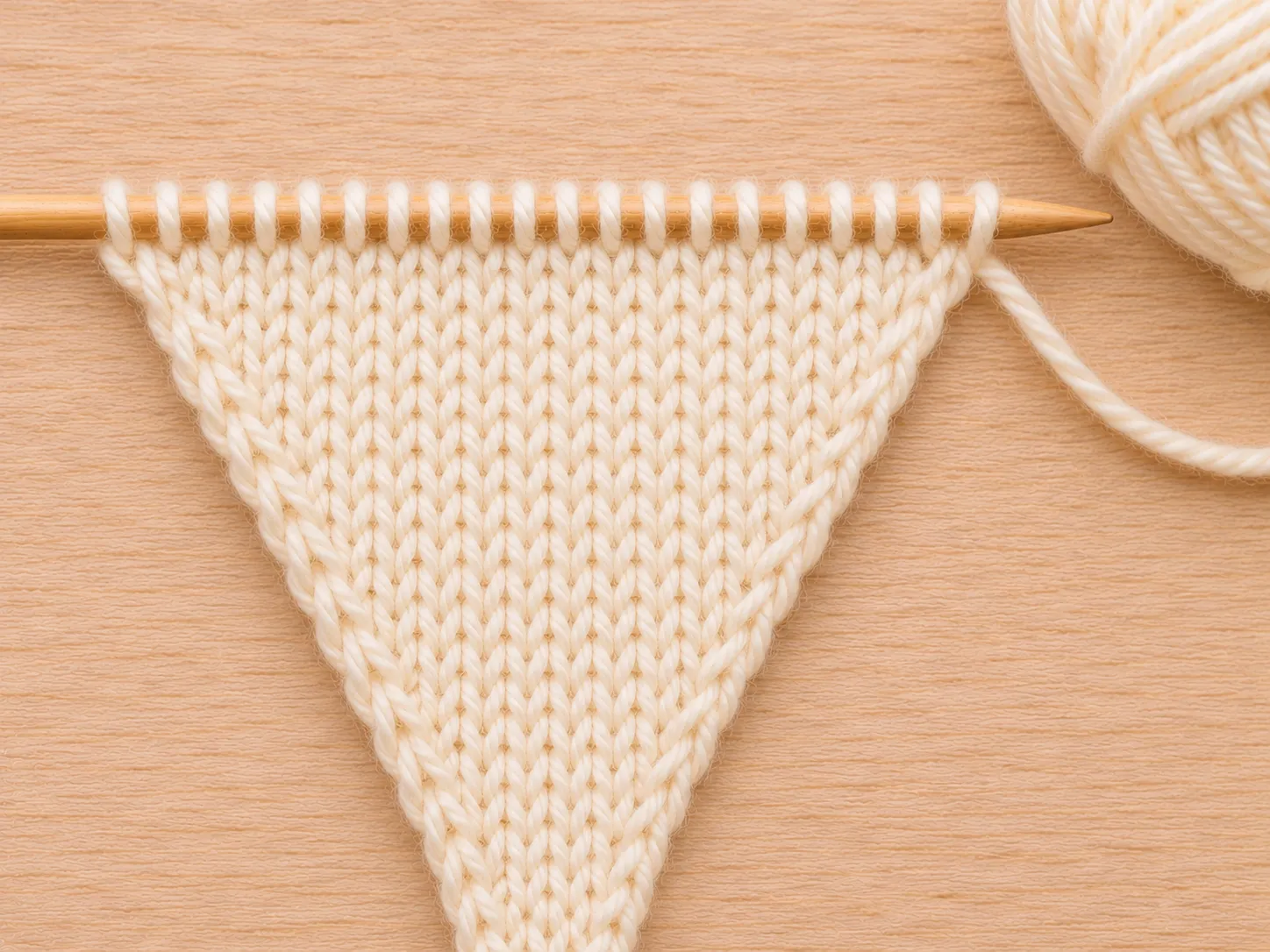
At a Glance
- Difficulty
- Intermediate
- Abbreviation
- M1
- Repeat
- Worked between any two stitches; increases 1 stitch
Practice with: A smooth, light-colored worsted (aran) wool on 5 mm (US 8) needles shows the strand between stitches clearly. Needles with pointed tips make lifting the strand much easier.
Used For
- Sleeve and body shaping
- Raglan and yoke increases
- Thumb and heel gussets
- Adding stitches after a ribbed edge
A near-invisible increase made by lifting the strand between two stitches and knitting it twisted - in left-leaning (M1L) and right-leaning (M1R) forms.
The make one increase creates a new stitch from the strand of yarn that runs between two existing stitches. Because the strand is twisted as you work it, the hole closes up and the increase almost disappears into stockinette, which is why patterns use it for shaping in visible places.
There are two versions that lean in opposite directions, so you can mirror increases on either side of a line - at the edges of a sleeve, along raglan lines, or at the sides of a thumb gusset. Patterns usually say which version goes where.
Because the new stitch is made from a short strand, it draws a little yarn from its neighbors, and the area can feel tight. That makes M1 slightly fussier than knit front and back, which is why it is often learned a little later.
Instructions
- Work to the point where the increase belongs. Gently pull the needle tips apart and look at the gap between the last stitch on the right needle and the first stitch on the left: a horizontal strand of yarn, often called the running thread or ladder, links them.
- M1L (make one left): insert the left needle tip under the strand from front to back, lifting it onto the left needle.
- Knit the lifted strand through the back loop - insert the right needle into the leg at the back of the left needle and knit it. This twists the strand closed and adds 1 stitch that leans to the left.
- M1R (make one right): insert the left needle tip under the strand from back to front, lifting it onto the left needle.
- Knit the lifted strand through the front loop, as for an ordinary knit stitch. This also twists the strand and adds 1 stitch that leans to the right.
- Check your work: a correctly worked M1 is closed at the base. If you see a hole, the strand was knitted through the wrong leg.
Tips & Notes
- Use stitch markers to mark where M1L and M1R go, so you can see the shaping line at a glance.
- To remember which is which, think of the direction you lift: for M1L the left needle enters from the front, and for M1R it enters from the back.
- If you are substituting M1 for another increase, swatch it first so you can check how it looks.
Common Mistakes
A small hole appears where the increase was made.
The strand was knitted untwisted - for example, lifted front to back and knitted through the front. Make sure the leg you knit into is the opposite of the way you lifted it, as in the steps above.
The increases lean the wrong way, so the shaping lines don't mirror.
M1L and M1R have been swapped. Lifting front to back gives M1L; lifting back to front gives M1R. Check one of each on a swatch so you recognize them.
The strand is too tight to knit.
Work the stitch on the needle tip and stretch the strand slightly before lifting it. Knitting the stitches on either side a little looser on increase rows also helps.
Variations
- Make one purlwise (M1P) - The strand is lifted in the same way and then purled, through the back or front leg, so it twists closed. It is used in reverse stockinette or in ribbing.
- Lifted increases - Instead of using the running thread, you knit into a stitch in a row below - the right leg of the stitch below the next stitch for a right lifted increase, or the left leg of the stitch two rows below the one just worked for a left lifted increase. They are equally discreet and also come in left and right versions.
- Knit Front and Back - An easier increase that knits twice into one stitch. It leaves a small visible bar, so it is less discreet than M1.
In Patterns
Patterns write M1L and M1R, or sometimes just M1. When a pattern says only M1, it usually means M1L, but check the abbreviations list. You may also see M1P (make one purlwise), for an increase that sits in a purl section.
Questions
What does M1 mean if it doesn't say left or right?
Most patterns use plain M1 for the left-leaning version, M1L. Check the pattern's abbreviations, and use M1R if you need a mirror.
Can I work an M1 at the very edge of the work?
No - an M1 needs a strand between two stitches. Work it at least one stitch in from the edge.
Is M1 better than kfb?
M1 is less visible in stockinette, while kfb is quicker and easier. Use whichever your pattern specifies.