Knit Front and Back (kfb)
Last updated November 12, 2026
At a Glance
- Difficulty
- Beginner
- Abbreviation
- kfb
- Repeat
- Worked into any one stitch; increases 1 stitch
Practice with: A smooth worsted (aran) yarn on 5 mm (US 8) needles makes it easy to see the bar that kfb leaves behind. Practice on garter stitch first, where the bar blends in.
Used For
- Increases in garter stitch
- Edge increases on shawls and blankets
- Simple shaping for beginners
- Increases where a little texture doesn't matter
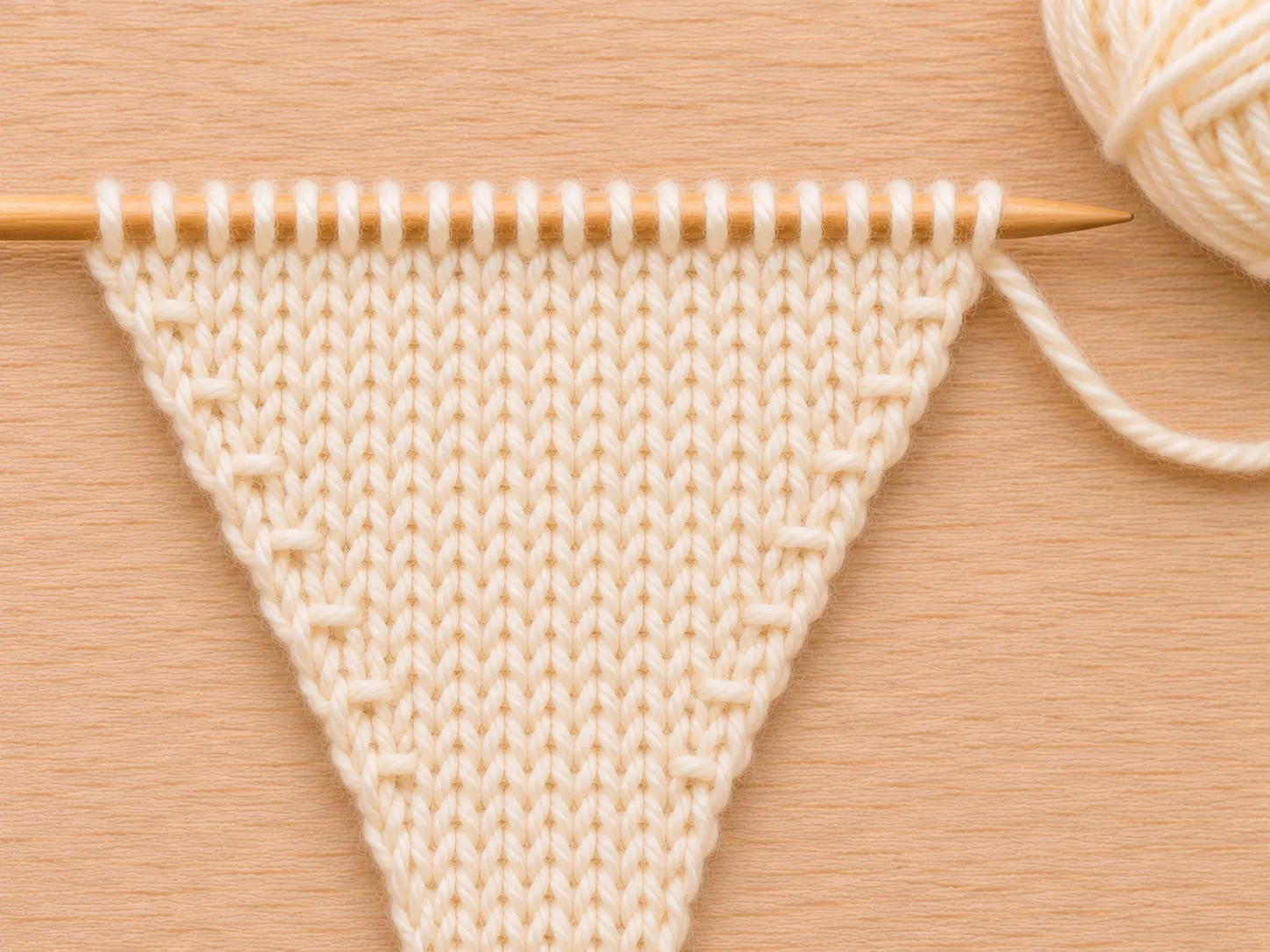
An easy, sturdy increase: knit into the front of a stitch and then into its back, turning one stitch into two and leaving a small purl-like bar.
Knit front and back, sometimes called the bar increase, is the easiest increase for many beginners because it uses a familiar movement: you knit the same stitch twice, once through each leg. It is sturdy and leaves no hole.
The trade-off is the little bar it makes on the right side. In garter stitch the bar disappears into the ridges, and in some patterns it is used deliberately as a design detail. In stockinette it is visible, so patterns often choose a make one increase instead when the increases need to be discreet.
Because the bar always appears on the left of the original stitch, the position of the kfb matters if you want matching edges. Working it into the first stitch and into the second-to-last stitch puts the bar one stitch in from each edge.
Instructions
- Work to the stitch where the increase belongs.
- Knit into the front of the stitch as usual - insert the needle knitwise, wrap the yarn and pull the loop through - but do not slide the old stitch off the left needle.
- Swing the right needle tip behind the left needle and insert it into the back loop of the same stitch, from right to left.
- Wrap the yarn around the right needle as if to knit and pull the loop through.
- Now slide the old stitch off the left needle. One stitch has become two, so you have increased 1 stitch.
- On the right side you will see a small horizontal bar, like a purl bump, at the base of the second of the two new stitches.
Tips & Notes
- On a garter stitch shawl, kfb gives an increase that blends in completely.
- Count your stitches after increase rows; kfb is easy to forget.
- If you need two increases next to each other, work kfb in two neighboring stitches rather than in the same stitch twice.
Common Mistakes
You end up with no extra stitch.
The old stitch slipped off after the first knit. Keep it on the left needle until you have knitted into the back loop as well.
The increases at each end of the row look different.
That is the bar sitting to the left of the stitch. Work the first increase in the first stitch and the last one in the second-to-last stitch, as in "kfb, k to last 2 sts, kfb, k1", so the bars mirror.
The back loop is too tight to get into.
Don't pull the working yarn tight after the first knit. Keep the loop on the left needle a little loose.
Variations
- Purl front and back (pfb) - Purl into the front of the stitch, then into the back. It is the wrong-side version and also increases 1 stitch.
- Knit front, back and front (kfbf) - Knit into the same stitch three times - front, back, front - to increase 2 stitches. It is used in bobbles and some textured patterns.
- Make One Increase - A less visible increase made from the strand between stitches, with left- and right-leaning versions.
In Patterns
Written as kfb, or sometimes "k1f&b" or "inc 1". A typical edge-increase row is "kfb, k to last 2 sts, kfb, k1", which adds 2 stitches.
Questions
Why does kfb leave a bump?
The second stitch is made through the back loop, and its base wraps around the original stitch, forming a small horizontal bar like a purl bump.
Can I use kfb instead of M1?
Usually yes - the stitch count is the same. The difference is in appearance: kfb shows a bar and M1 is almost invisible.
Is kfb the same as inc 1?
In many older or simpler patterns, "inc 1" means kfb. Check the pattern's notes.