Stitch n Pattern — https://stitchnpattern.com/patterns/round-coasters.html
Round Crochet Coasters
Last updated November 12, 2026
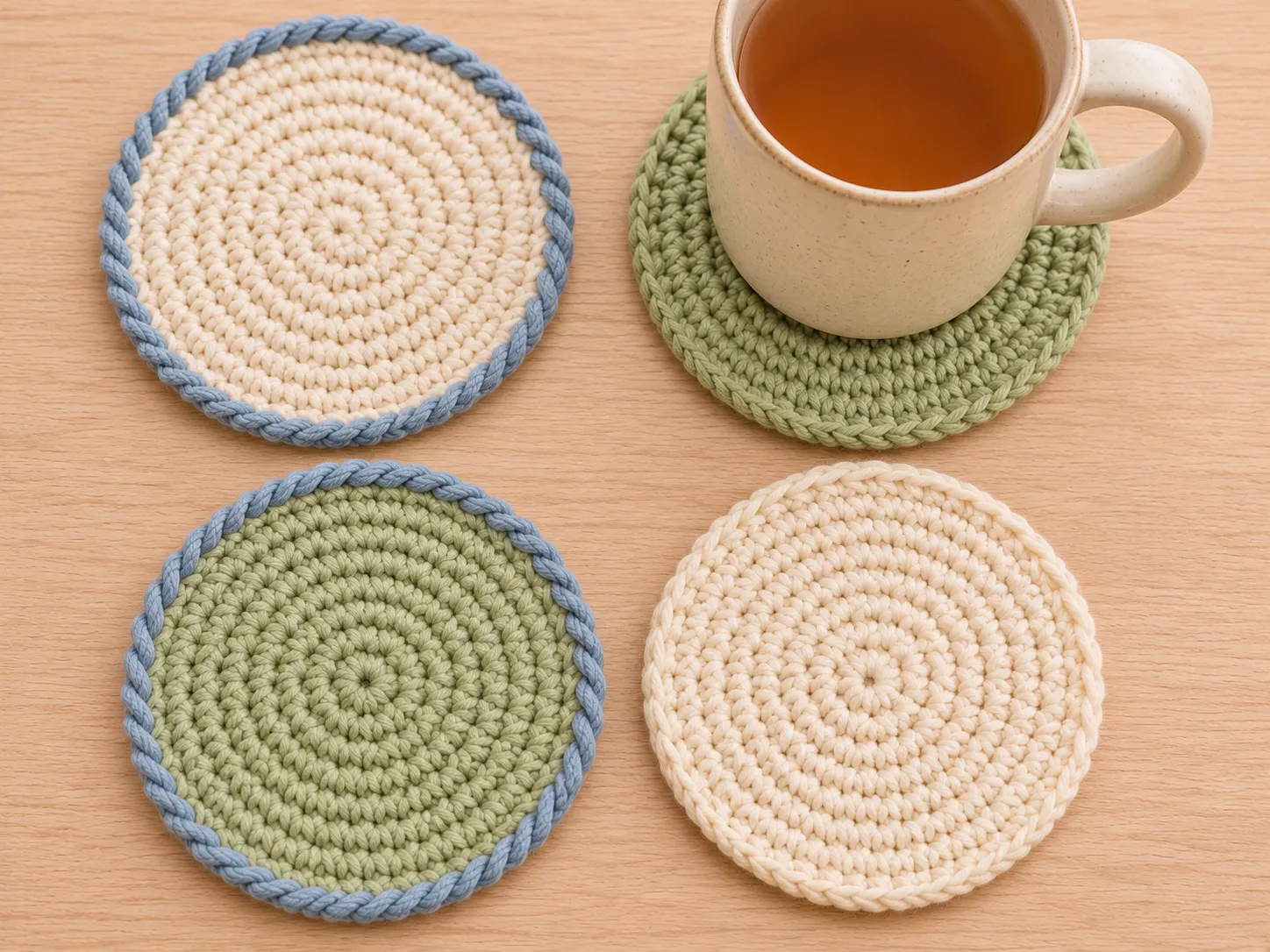
Pattern Details
- Craft
- Crochet
- Difficulty
- Beginner
- Finished size
- About 4 in (10 cm) across, or about 4.5 in (11.5 cm) with the edging
- Time
- About an hour per coaster
- Gauge
- Gauge isn't critical, but crochet firmly: a dense fabric protects the table better and helps the coaster stay flat.
Materials
- Worsted/aran weight 100% cotton yarn, about 20 yd (18 m) per coaster - one 2.5 oz (70 g) ball of about 120 yd (110 m) makes a set of four with the edging
- 4 mm (US G-6) crochet hook
- Stitch marker
- Tapestry needle
- Scissors
Stitches Used
- Amigurumi Magic Ring / Magic Circle
- Chain Stitch
- Single Crochet
- Half Double Crochet
- Slip Stitch
- Working in the Round (Spiral and Joined Rounds)
- Reverse Single Crochet (Crab Stitch)
- Fastening Off and Weaving In Ends
Abbreviations
- ch
- chain
- sl st
- slip stitch
- sc
- single crochet (UK: double crochet)
- hdc
- half double crochet (UK: half treble crochet)
- inc
- increase: 2 sts (sc or hdc, depending on the version) in the same stitch
- rev sc
- reverse single crochet (crab stitch)
- rep
- repeat
- st(s)
- stitch(es)
Free round cotton coaster patterns in single crochet or half double crochet, with every increase round counted and an optional reverse single crochet edge.
This pattern uses US crochet terms - see the US vs UK crochet terms chart to convert.
A flat circle is one of the most useful shapes in crochet, and a set of coasters is the perfect way to practice it. You start in the center with a magic ring and add the same number of stitches on every round, which keeps the circle flat instead of cupping or rippling.
Two versions are given: a dense single crochet coaster and a quicker half double crochet one. Both are worked in cotton, which absorbs drips and washes well, and both can have an optional reverse single crochet edge for a corded, rope-like border.
You'll learn how increase rounds work, why the increases are shifted on alternate rounds to keep the circle round rather than turning into a hexagon, how to join rounds neatly with a slip stitch, and how to work reverse single crochet for a firm, decorative edge.
Pattern Notes
- Each round is joined with a sl st to the first stitch of the round. The ch 1 (sc version) or ch 2 (hdc version) at the start of a round does not count as a stitch; work the first stitch of the round into the same stitch as the join.
- Put a marker in the first stitch of each round so you can find it to join.
- On every other round the increases are shifted by half a repeat. If the increases sit on top of each other every round, the circle slowly turns into a hexagon (sc) or octagon (hdc).
- The sc version adds 6 stitches per round and the hdc version adds 8, because hdc is taller and each round makes a bigger jump outward.
Single crochet version
- Round 1: Make a magic ring, ch 1, 6 sc in ring. Pull the ring closed and join with a sl st to the first sc. (6 sts)
- Round 2: Ch 1, inc in each st around, join. (12 sts)
- Round 3: Ch 1, *sc in next st, inc; rep from * 5 more times, join. (18 sts)
- Round 4: Ch 1, sc in next st, inc, *sc in next 2 sts, inc; rep from * 4 more times, sc in next st, join. (24 sts)
- Round 5: Ch 1, *sc in next 3 sts, inc; rep from * 5 more times, join. (30 sts)
- Round 6: Ch 1, sc in next 2 sts, inc, *sc in next 4 sts, inc; rep from * 4 more times, sc in next 2 sts, join. (36 sts)
- Round 7: Ch 1, *sc in next 5 sts, inc; rep from * 5 more times, join. (42 sts)
- Round 8: Ch 1, sc in next 3 sts, inc, *sc in next 6 sts, inc; rep from * 4 more times, sc in next 3 sts, join. (48 sts)
- Round 9: Ch 1, *sc in next 7 sts, inc; rep from * 5 more times, join. (54 sts)
- The coaster should measure about 4 in (10 cm) across. Work the edging below, or fasten off, leaving a 6 in (15 cm) tail.
Half double crochet version
- Round 1: Make a magic ring, ch 2, 8 hdc in ring. Pull the ring closed and join with a sl st to the first hdc. (8 sts)
- Round 2: Ch 2, inc in each st around, join. (16 sts)
- Round 3: Ch 2, *hdc in next st, inc; rep from * 7 more times, join. (24 sts)
- Round 4: Ch 2, hdc in next st, inc, *hdc in next 2 sts, inc; rep from * 6 more times, hdc in next st, join. (32 sts)
- Round 5: Ch 2, *hdc in next 3 sts, inc; rep from * 7 more times, join. (40 sts)
- Round 6: Ch 2, hdc in next 2 sts, inc, *hdc in next 4 sts, inc; rep from * 6 more times, hdc in next 2 sts, join. (48 sts)
- The coaster should measure about 4 in (10 cm) across. Work the edging below, or fasten off, leaving a 6 in (15 cm) tail.
Optional reverse single crochet edging (either version)
- Edging round: Ch 1. Working backward around the circle - from left to right if you crochet right-handed - rev sc in each st around. Join with a sl st to the first rev sc. (54 sts for the sc version, 48 sts for the hdc version)
- Fasten off, leaving a 6 in (15 cm) tail.
Finishing
- Weave the tails into the back of the stitches, changing direction once so they cannot work loose, and trim.
- Dampen the coaster, pat it into a flat circle and leave it to dry. Cotton can also be pressed with a steam iron under a cloth.
Tips
- If the circle cups up like a bowl, check for a missed increase first; if the count is right, crochet a little more loosely. If it ripples, check for an extra stitch, then try a little tighter.
- Use 100% cotton: acrylic does not absorb drips and can soften or melt under a very hot mug.
- If the reverse sc edge ripples, work it with a hook one size smaller.
- Make all the coasters in a set at one sitting if you can - your tension changes less, so they match in size.
Variations
- Two colors - Change color at a join: drop the old color and finish the joining sl st with the new one. A contrast edging round alone makes a simple set look finished.
- Hexagon coasters - In the sc version, stack the increases instead of shifting them, so Rounds 4, 6 and 8 are worked like the odd rounds (for example, Round 4: *sc in next 2 sts, inc; rep from * 5 more times). The circle becomes a neat hexagon.
- Bigger mats - Keep going with the same plan - 6 more sts per round for sc, 8 more for hdc, shifting the increases on every other round - until it is the size of a placemat or pot stand.